Secretary-General’s reflection: LAND.TECHNIK AgEng 2026, Dresden, Germany.
 admin
I left the welcome get-together with a strong sense of what makes our community valuable: the opportunity to bring researchers, industry colleagues and the next generation of engineers into the same conversation.
The TU Dresden presentations formed part of that welcome event, and their soil-bin demonstrations gave us a practical view of research in action. Measuring tillage forces and using laser scanning to map soil surfaces showed how careful experiments can help us understand machine–soil interaction.
The keynote by Eva Schroer-Merker and Berndt Fehlker from Krone brought us to the challenges farmers face: labour shortages, rising costs, narrow operating windows, regulation and climate uncertainty. Autonomous systems may help address some of these pressures, but they do not make complexity disappear.
They change the work and bring new requirements for skilled oversight, reliable service, interoperability, data management and safe responses to unexpected situations. For me, the key question is not simply whether autonomy solves problems, but whether we can adapt farming systems so that it delivers practical value?
Later, Volker Stöcklin from Rauch’s gave his keynote to the EurAgEng Young Professional Network (YPN) session. He offered an industry perspective on innovation and engineering careers. It underlined the continuing importance of strong engineering fundamentals, collaboration and a willingness to keep learning
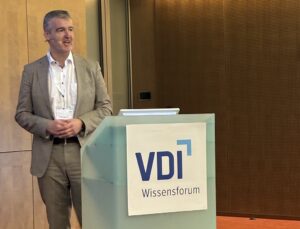
The follow-up YPN sessions made the value of that community clear. Harsh Sahu focused on helping young researchers connect with an audience; Lucas Caye introduced VDI Young Engineers and the opportunities professional networks create; and Filippo Piccino’s interactive session invited participants to think through safety and trust in autonomous tractors
The technical programme also reminded us that innovation relies on sound evidence. Fabian Uhlig and Andreas Andersen presented experimental data acquisition for DEM simulation of threshing processes. Their mobile test stand links laboratory characterisation with field measurements, allowing model predictions to be compared with observed grain separation.
The model captured broad trends, while overpredicting early separation—a useful example of the continuing challenge of representing crop variability and crop-mat behaviour accurately.
On the second day, Fridolin Schuler and Johannes Utz shared lessons from developing the Fendt Xaver GT. The evolution from early lightweight concepts towards a more robust, task-focused machine illustrated that autonomy is not an end in itself.
A new form factor must address a real farming need, deliver value, meet safety requirements and fit within established agricultural systems.
Felix Gerdes’s work on decentralised energy supply explored how farm-specific, time-resolved energy demand could inform biomethane infrastructure sizing. Seasonal peaks and refuelling patterns mattered as much as annual demand, with potential for cross-farm use to improve plant utilisation.
The conference’s final keynote, from Cornelia and Michael Horsch, widened the lens to digitalisation and AI. They stressed that successful transformation depends less on technology alone than on people, organisational culture and the ability to rethink everyday processes.
Finally, I want to offer sincere thanks to Dr Markus Demmel as he retires from his role. His decades of service, including his leadership and sustained contribution to the agricultural engineering community, deserve our deep gratitude.
I take away a clear message: agricultural engineering progresses when research, industry and professionals learn from one another.
Our responsibility is to develop technology that is safe, practical and economically credible—and to keep building a community willing to question, test and improve it together.
Lots to think about on the way home.
Andy
\ Get the latest news /